
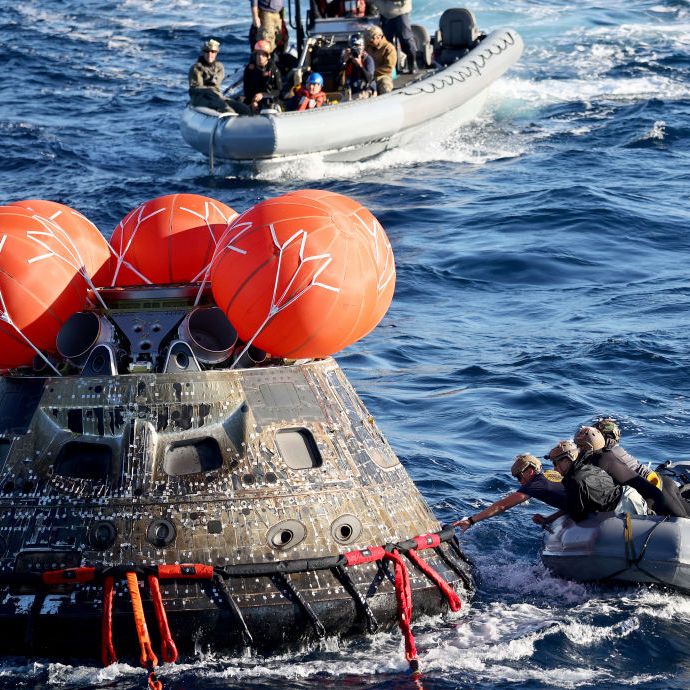
After weeks of anticipation and a journey that pushed the boundaries of human space exploration, the NASA Artemis II crew capsule has made its long-awaited return to our home planet. The module, which carried a team of astronauts on a pivotal mission around the Moon, concluded its voyage with a controlled and highly precise splashdown. This final phase of the flight unfolded exactly as mission planners had hoped, marking a major milestone in NASA’s broader campaign to reestablish a sustained human presence beyond low Earth orbit.
The splashdown itself was a carefully choreographed event, with the capsule blazing through the upper atmosphere before deploying a series of parachutes to slow its descent. As the spacecraft gently settled into the ocean waters, recovery teams stationed nearby quickly moved in to secure the module and prepare for the astronauts’ extraction. Unlike earlier test flights, this mission carried a live crew, which added layers of complexity and risk to every stage of reentry. The flawless execution of this landing therefore stands as a testament to years of rigorous training and engineering refinement.
From a technical standpoint, the success of this splashdown validates several critical systems that had not been fully tested with humans aboard until now. The heat shield endured extreme temperatures generated during reentry, while the navigation and guidance software performed with pinpoint accuracy, steering the capsule to its targeted landing zone. Engineers will now retrieve onboard data and inspect the vehicle’s exterior for any signs of unexpected wear. These observations will directly inform design tweaks for subsequent Artemis missions, including the eventual lunar landing attempt.
Beyond the engineering achievements, the safe return of the Artemis II crew carries profound symbolic weight. It signals that humanity is ready once again to venture far from Earth’s protective embrace, not merely as visitors but as the first builders of a lasting lunar infrastructure. The astronauts themselves, having peered at the Moon’s far side and witnessed our planet suspended in the blackness of space, will now undergo medical checks and share their firsthand accounts with scientists and the public. Their experiences will help shape everything from life support protocols to the psychological preparation of future deep-space explorers.
Looking ahead, this successful splashdown clears a major hurdle for the Artemis program, bringing the next chapter a crewed lunar landing closer to reality. Every parachute deployment, every communication handoff, and every second of the reentry corridor provided invaluable lessons that cannot be replicated in simulations. With this mission now in the books, NASA and its international partners can move forward with greater confidence toward the ultimate goal of establishing a permanent foothold on the Moon, and eventually sending astronauts to Mars. The capsule bobbing gently in the ocean is more than a returning vehicle; it is a promise that the best of space exploration is still to come.